

Articles and News




Leslie McGwire: Your Logo’s Part in Your Store Design Story-Part Two of Two | October 25, 2025 (0 comments)

West Bloomfield, MI--You have one chance to get this right.
A logo is a jewelry company’s first introduction to consumers. If designed well, it can pique the interest of the public and invite them to learn more about the company. If not, you’ve just alienated a potential customer base and basically tanked your business.
This first impression is your way to immediately communicate ownership over the product(s) of jewelry you sell or niche you dominate. Your logo introduces your company as an authority in your professional space from the get-go.
When it comes to using your logo, remember that you constantly want to reinforce your brand everywhere possible and ensure that a customer remembers your store. Therefore, the use of your logo should be thought about, whether that customer is standing inside your store, outside your door, or even in their own living room.
Your logo is their constant touch point and reminder of what you stand for, the experiences they’ve had with your business and, in the case of jewelry, the joy you have brought to their lives with your beautiful, quality products.
Usage Outside Your Store
Outside your store your logo should appear on all things that will help remind them of you: your invoices, bags, boxes and packaging, business cards, brochures, emails. Anything that a customer will receive at home or take home, your logo should be prominent.
Your logo should always be prominent in any advertising that you do. It should appear on catalogs if you do them; If your store is engaged in a public relations program, your logo should appear on each press release. Images that you supply for those releases should be photographed with your store logo or store signage in the background.
Products should be photographed with a logoed box or counter pad in the background, on which your logo is viewable.
Obviously, your website is an extension of your store.
Your logo should appear not only on the landing page, but on each of the subsequent website pages. If possible, all product images should have your logo visible as the backdrop.
A Powerful In-Store Element
Within the design of your store your logo can also be a powerful element.
Something clear, easy to read and perfectly placed is not only a strong reminder (getting the customers attention) but it can also help define the space, especially if spotlighted or well lit.
One trick that I like to suggest is placing LED lighting behind a logo so that it glows and stands out in the space. The LED lights also give the logo a high-end appearance. Treating logos in a similar manner as part of your store design and using them to create eye interest can help bring people through the door. Additionally, they can give off subtle messages of elegance and exclusivity.
I usually advise store owners to use their logos in a more prominent manner in areas of their stores that are highly trafficked or have higher profitability or sales. For example: if you are selling many diamond pieces in your store, your store logo should be used in your diamond area in a more prominent way, making that area stand out and pop.
This should be thought of early in the store design process so that floorplans and lighting can help augment the effect.
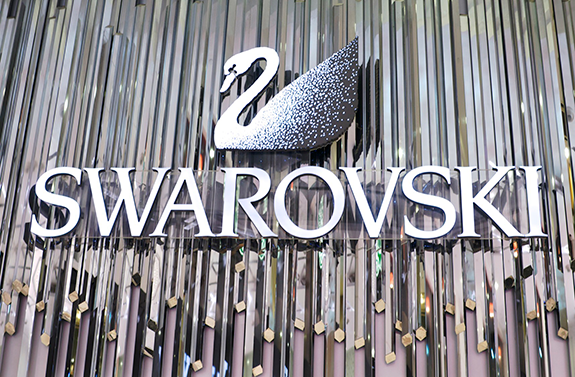
Widely known Swarovski Logo above. Photo Credit: Istock.com-whatthedave
Logos Fosters Brand Loyalty
Say it with me: Consumers crave consistency. As your brand grows, your logo is going to become more familiar to a wide range of consumers, and this familiarity creates the perception that you’re trustworthy and accessible.
Once they like you, your customers are going to seek you out again and again – and your logo is the thing they’ll look for first. Your logo is something that should stand the test of time and not something that is changed easily or often.
However, there may come a time that your store has evolved, and you need your logo to convey new subliminal and subtle messages. For example, the Swarovski swan has been an iconic part of the brand logo since 1988. The swan is synonymous with elegance and grace.
It became the Swarovski symbol to indicate the heritage of high quality. However, as the company evolved, changed its focus and its product offering, so did the logo and the swan. In 2016 the swan image evolved to a smooth gradient in the body of the swan instead of the earlier, more random placement. Additionally, the font evolved to a leaner and cleaner look that is now often used without the iconic swan image.
Logo Separates You from Competition
Dare to be different with your logo because your company logo tells consumers why your business is unique. Sure, maybe there are 10 other jewelry stores around your city, but yours is the only one that’s committed to sustainability, and your logo drives that message home.
A well-designed company logo can communicate everything from the company’s background (professional, relaxed, fun) to their mission (entertainment, efficiency, and innovation) through the right icon or proper font. In other words, your logo is the forum to both convey your values and show consumers why you’re not like your competitors and your jewelry store is better.
When it comes time to reimagine your logo, think about your store, your brand, what it means to you and what you want it to say subliminally when customers see it. Where has it come from and where is it evolving to?
- Remember to apply the same rules I mentioned before in terms of scalability and color.
- Remember to think about the messages various font styles portray.
- Remember to think about what the colors you choose connote for a consumer. While black and white or gold and silver logos are classic and stylish, they may not translate well into a variety of elements, and may be hard to reproduce exactly across the various habitats.
- Full-color logos can feature a mix of colors and portray boldness, fashion-ability or structure and establishment. I always suggest no more than 3 colors be used in a coordinating color palette that can be used to create the mood and feel across all the elements of your showroom.
- One color should always be the most dominant or prominent color. For example, Rolex and their use of green keeps them bright, distinct and memorable, while the typeface is very simple and straightforward.
- Remember that your logo should be placed onto a variety of elements such as your packaging, website, point of sale and so forth. View each of your new logo contenders in a variety of contexts to make sure it translates into each place comfortably.
- Finally, remember that all the messaging that you share with a customer, all the colors, all the font’s go toward creating a total experience. That experience and those prompts need to be carried out across everything you do and used throughout your store décor.
- The physical shopping experience starts with a good design. However, the emotional shopping experience starts well before that; from the first time they see your logo.
- Make sure your logo expresses the elements of your brand and that your inviting store design will turn a mere passer-by into an inquisitive shopper.
In Summary--What is a Logo?
What is a logo and why is it important for your brand? Have you ever noticed that you are exposed to thousands of logos daily? Think about it, whether you’re scrolling through your Instagram feed, or just grabbing a few items, you are constantly making connections with brands, oftentimes, without even realizing it.
While it may seem insignificant, these small but mighty symbols are a part of our daily lives—and an integral part of your branding efforts. When done right, a logo serves as the face of your business and helps your audience recognize who you are and what you stand for and represents your brand's personality.
In the simplest terms, a logo is a symbol composed of words, images, and colors that is used to identify a brand or product. Specific logos come in all different shapes and sizes that run the gamut from simple text logotypes to abstract logos.
In conclusion, Paul Rand, the father of graphic design once said, “A logo doesn’t sell (directly), it identifies." Remember that your logo is like the soul of your company, and as such it should be consistent, recognizable and evoke a positive or meaningful feeling. A good logo should infuse the spirit of your brand throughout all visual elements and marketing channels. While a logo’s main function is to help identify, it does much more.
About the Author: Leslie McGwire™ has over 35 years in tech-business development, interior design, equipment, furniture sales and marketing services in retail and jewelry-based businesses. Leslie has won over 25 national design awards, including the prestigious Salon Today and INSTORE Jewelry Store awards. Leslie has a true passion about businesses to create environments that inspires both customers and staff. Visit lesliemcgwire.com for more information.