

Sales Strategy




Leslie McGwire: Building on the Many Inherent Advantages of In-Store vs. Online | March 15, 2026 (0 comments)

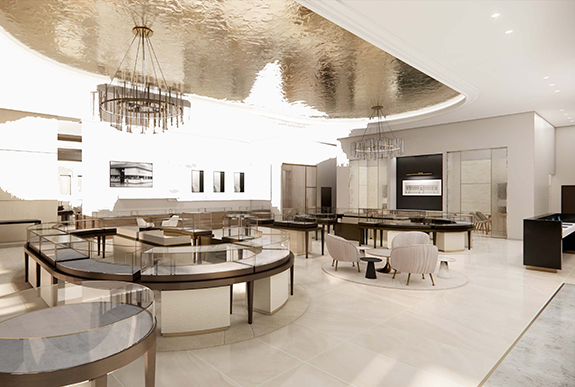
West Bloomfield, MI--Jewelry stores have moved far beyond luxury in most cases. Experiential marketing for jewelry brands now shapes how customers discover, engage with, and stay loyal to the labels they love. Jewelry stores have become stages from interior design services for multisensory events to invitation-only activations and cultural installations that blur the line between boutique and destination. The brands winning in this climate are those treating every customer interaction as a data point and a relationship. See jewelry store rendering below.
Key takeaways on the exclusive jewelry shopping experience
- Experiences outperform goods. Jewelry consumers are spending more on experiential indulgences on jewelry, a trend that accelerated sharply through 2024 and 2025.
- Exclusivity drives loyalty. Invite-only events and private activations create the word-of-mouth and brand advocacy that paid media cannot replicate.
- Physical stores must earn their floor space. Stores that blend jewelry retail, hospitality, and entertainment into a single experience see higher dwell time and stronger conversion.
- First-party data is the engine behind personalization. Retailers that capture interaction data, not just purchase history, can deliver experiential campaigns that feel genuinely personal at scale.
- AI makes one-to-one engagement scalable. Technology now lets retailers and jewelry brands run individualized outreach, track engagement across channels, and attribute revenue to specific customer relationships.
Jewelry Stores Are Becoming Experiential Destinations
Jewelry "flagship" stores have been reinvented. Where boutiques once focused exclusively on display and transaction, leading luxury jewelry brands now design spaces that serve as lifestyle hubs—part retail, part cultural venue, and part social experience. The Tiffany Blue Box Café extends the brand's signature aesthetic into breakfast and afternoon tea. Guests become immersed in the brand's identity before touching a single piece of jewelry, and they leave with a memory, not just a receipt.
Engineering Every Sensory Detail
Experience design in jewelry stores means engineering every sensory detail—sound, scent, lighting, pacing—to reinforce brand identity. Stores that do this well report longer visit times and measurably higher average order values. Interactive mirrors, 3D projection mapping, and AI-driven recommendation terminals are no longer novelty features. They are becoming standard infrastructure for any jewelry stores serious about competing for the attention of premium customers.
The high-end jewelry store market is at a turning point. The sector faces challenges due to slowing global demand, shifting luxury consumer behavior, and rising expectations around digitalization, sustainability, and inclusivity.
The challenge for luxury jewelry retailers will be to maintain exclusivity while adjusting to new price sensitivity and evolving to meet the needs of younger, more diverse luxury consumers.
First, affordable luxury and entry-level categories speak to new luxury consumers. Meanwhile, jewelry and watches stand out as investment pieces among more affluent consumer groups.
Second, luxury jewelry consumers value experience over ownership. The luxury consumer behavior shows that experiences are increasingly prioritized over ownership, boosting the jewelry and immersive events categories. The value of experience goes beyond the purchase of specific experiences and extends to the purchasing of jewelry. The in-store and post-purchase experiences can be enhanced through invitation-only events, VIP access, and exclusive services that help cultivate community and reinforce exclusivity.
Third, exclusivity can be retained in luxury jewelry stores through a scarcity mindset. Offering limited edition collections and one-of-a-kind items is a key strategy. Social media has become a valuable tool for brands to create scarcity and excitement through exclusive online product drops and private virtual communities. In an increasingly digital world, physical retail is evolving into a stage for immersive brand storytelling. See another jewelry store rendering below.
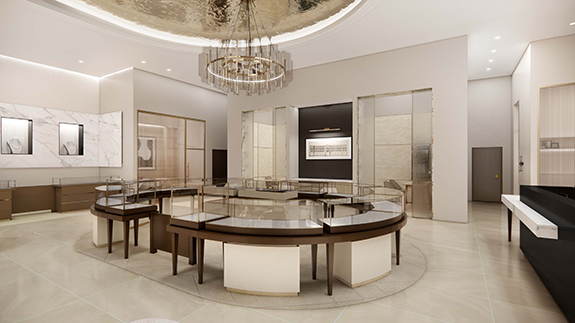
The use of online stories and spaces for research may have become an integral part of the purchasing journey, but the store experience remains key. Therefore, jewelry stores remain important and can help elevate customer satisfaction in the luxury segment. The significant investment in the brick-and-mortar store introduced LED walls, comfortable seating, drink bars and many more design elements.
Luxury jewelry beyond price and status
While price and prestige have long been key to defining luxury, younger shoppers are looking beyond these features and perceive luxury to be tied to quality, uniqueness, and self-expression. Jewelry is more about individuality and emotional connection. Offering personalization and opportunities to co-create can incite interest among younger generations, who primarily want to express their individuality through jewelry and experiences that reflect that. Bespoke jewelry, customization, limited editions, and opportunities to co-create with jewelry brands resonate strongly, highlighting the shift in luxury consumer behavior toward a personalized demand.
About the Author: Leslie McGwire™ has over 35 years in tech-business development, interior design, furniture sales and marketing services in retail and jewelry-based businesses. Leslie has won over 25 national design awards, including the prestigious Salon Today and INSTORE Jewelry Store awards. Leslie has a true passion about businesses to create environments that inspire both customers and staff. Visit lesliemcgwire.com for more information.